Routinized Deference: Predictive Screening and Bureaucratic Capacity in Child Protective Services
Published in Job Market Paper · Revise & Resubmit, Journal of Public Administration Research and Theory (JPART), 2025 [link to paper]
Overview
Public agencies increasingly hand frontline screening decisions to predictive algorithms, on the premise that doing so sharpens judgment and frees scarce capacity. Whether it holds in practice is another matter. Using NCANDS data from 2010 to 2023 and a stacked difference-in-differences design, I examine how the adoption of predictive screening reshaped decision-making in U.S. Child Protective Services. Algorithm adoption does not increase the number of investigations, and it produces a substantial decline in substantiation rates—evidence, I argue, of eroding rather than expanding capacity. To make sense of this, I develop the concept of routinized deference: under caseload pressure, caseworkers default to the algorithm’s recommendation, and their work shifts from analyzing cases toward verifying the tool and managing its exceptions.
This is my job market paper. The manuscript is under revision for resubmission.
Research Design
- Data: NCANDS Child File, 2010–2023
- Outcome Variables:
- Investigation volume (operational capacity)
- Substantiation rate (analytical capacity)
- Treatment: County-level adoption of predictive screening tools
Key Findings
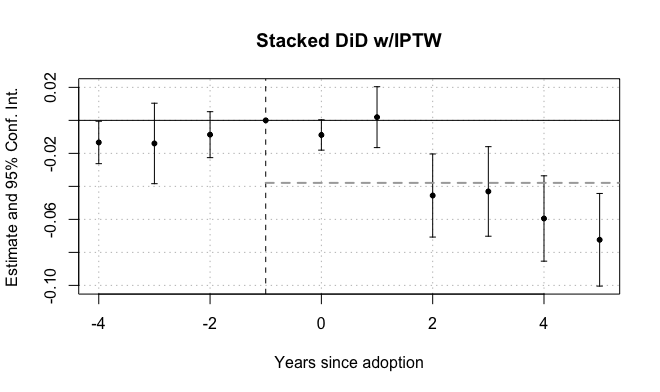
1. Substantiation rates fall by ~15% after algorithm adoption
- Indicates declining analytical capacity.
2. No increase in the number of investigations
- Rejects the hypothesis that operational capacity improved.
3. Investigations take longer
- Average investigation duration increases by 7.36 days (≈14%).
4. Effects concentrate among high-yield referrals
- Declines only among referrals from professional reporters.
- No change for informal low-yield referrals.
- Supports a misclassification mechanism.
5. No new racial disparities
- White and non-white substantiation rates fall in parallel.
- Pseudo-algorithm tests show nearly identical ROC curves.
- Capacity erosion is uniform, not group-specific.
Overall mechanism: Routinized Deference
Street-level staff default to algorithmic recommendations under caseload pressure, crowding out analytical judgment and slowing case processing while lowering yield.
Results
Figure 1. Decline in substantiation rates after adoption