Routinized Deference: Predictive Screening and Bureaucratic Capacity in Child Protective Services
Published in Working paper, 2025
Overview
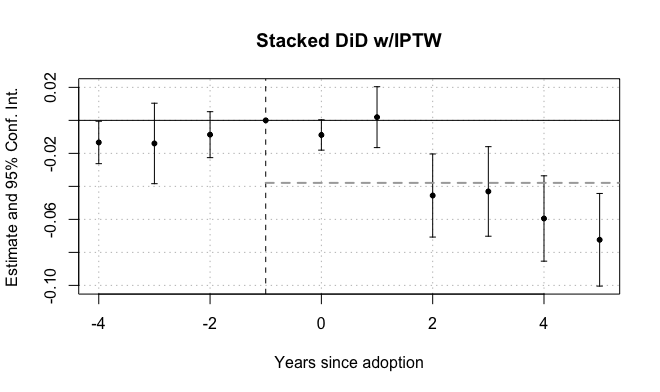
This paper evaluates how predictive screening algorithms reshape frontline decision-making in U.S. Child Protective Services (CPS). Using NCANDS data (2010–2023) and a stacked difference-in-differences design, I show that algorithm adoption does not increase the number of investigations and produces a substantial decline in substantiation rates, indicating erosion of bureaucratic capacity.
I develop the concept of routinized deference, arguing that street-level bureaucrats under time pressure default to algorithmic recommendations, shifting their work from case analysis to verification and exception management.
Research Design
- Data: NCANDS Child File, 2010–2023
- Outcome Variables:
- Investigation volume (operational capacity)
- Substantiation rate (analytical capacity)
- Treatment: County-level adoption of predictive screening tools
Key Findings
1. Substantiation rates fall by ~15% after algorithm adoption
- Indicates declining analytical capacity.
2. No increase in the number of investigations
- Rejects the hypothesis that operational capacity improved.
3. Investigations take longer
- Average investigation duration increases by 7.36 days (≈14%).
4. Effects concentrate among high-yield referrals
- Declines only among referrals from professional reporters.
- No change for informal low-yield referrals.
- Supports a misclassification mechanism.
5. No new racial disparities
- White and non-white substantiation rates fall in parallel.
- Pseudo-algorithm tests show nearly identical ROC curves.
- Capacity erosion is uniform, not group-specific.
Overall mechanism: Routinized Deference
Street-level staff default to algorithmic recommendations under caseload pressure, crowding out analytical judgment and slowing case processing while lowering yield.
Results
Figure 1. Decline in substantiation rates after adoption